Short answer: Before buying land to build in Cabarete or Sosúa, confirm four legal points with a lawyer (title in the seller’s name, individual deslinde, no liens, no protected-zone or coastal restrictions) and eight physical points with a builder: road access, slope, soil, drainage, water, electricity, sewage and the real buildable area after setbacks. Skipping any of them can add months or tens of thousands of dollars to your build.
Key takeaways
- A cheap lot is often an expensive build. Access, slope and soil change your foundation cost more than the price per m² of the land.
- Never pay a deposit before a lawyer confirms the title and the deslinde (individual survey).
- The buildable area is not the lot size. Setbacks, the coastal public zone and easements reduce it.
- Water, power and sewage are not guaranteed on every lot on the north coast. Ask how each one reaches the property.
- Bring your builder to see the lot before you sign. A one-hour visit can save a bad purchase.
Most of the people who call us already own a lot. Some of them bought well. Others bought a beautiful view with no road for a concrete truck, or a lot where the “survey is coming soon.” This checklist is what we look at when a client asks us to visit a lot before they buy it.
This article is general information from a builder’s point of view, not legal advice. The legal checks must be done by a Dominican real estate lawyer.
Can a foreigner buy land to build in the Dominican Republic?
Yes. Foreigners can buy land and build in the Dominican Republic in their own name or through a Dominican company, on the same terms as Dominican citizens (Foreign Investment Law 16-95). No residency is needed to buy. The limits are about location, not nationality: coastal public land, protected areas and land near the Haitian border have special rules.
That is why the legal checks below matter more than your passport.
Buying land to build in Cabarete: the 4 legal checks (your lawyer does these)
1. Is the title registered in the seller’s name?
The lot must have a Certificate of Title (Certificado de Título) registered at the Registro de Títulos, and the person selling must be the registered owner or have a valid power to sell. Your lawyer requests a certificación de estado jurídico from the registry to confirm the owner and any burdens on the property.
Red flag: the seller has “papers” but not a registered title, or offers a sales contract on land that is still in an inheritance process.
2. Does the lot have its own deslinde?
The deslinde is the legal survey that separates your lot from a bigger parcel and gives it its own title and cadastral designation. Buying a lot that already has its own deslinde is safer and faster than buying a share of a larger parcel (governed by the Real Estate Registry Law 108-05).
Why a builder cares: without the deslinde, the permit process stalls, because the building permit requires the final title and the cadastral plan of the lot (inmobiliario.do; see our guide to construction permits in Puerto Plata).
Red flag: “The survey is coming, you can start paying now.”
3. Are there liens, mortgages, disputes or occupants?
The registry certificate shows mortgages and legal annotations. It does not show everything: unpaid municipal taxes, a neighbour using part of the lot, or a family dispute. Your lawyer checks the documents. We walk the boundaries and look at what is physically there: fences, sheds, paths, someone growing plantains on “your” land.
4. Is the lot in a coastal, river or protected zone?
The first 60 metres from the high-tide line along the coast are public land, and building there is not allowed under Law 305 of 1968 and the Environment Law 64-00 (elCaribe). Similar restrictions apply near rivers, wetlands and protected areas. A beachfront lot can be far smaller in practice than it looks on the listing.
Ask your lawyer to confirm land use with the municipality (ayuntamiento) and, for coastal or rural lots, with the Ministry of Environment before you sign.
The 8 physical checks (your builder does these)
5. Can a concrete truck reach the lot?
This is the first thing we look at. A foundation and a slab need concrete trucks, pumps and deliveries of block and steel. A narrow dirt road, a steep hill or a footpath means smaller deliveries, more labour and more days.
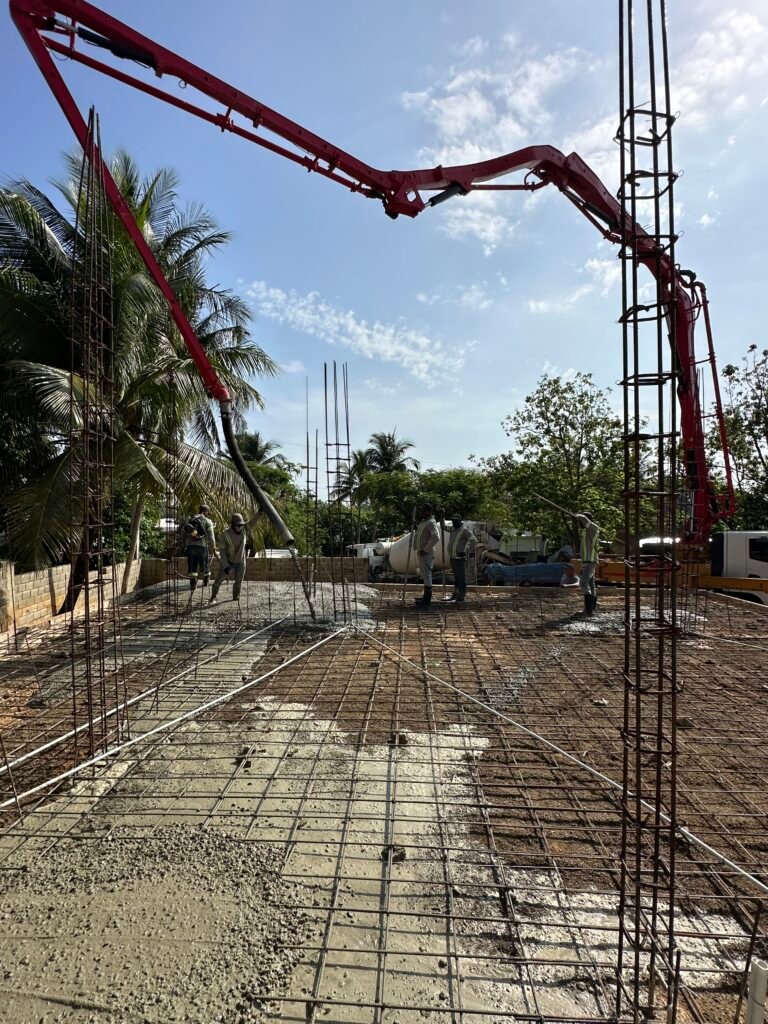
On a slab pour like the one above, the truck and the pump need to get close. If they cannot, the cost of that day changes. When materials have to be carried by hand, the same work needs more people and more days.
6. How steep is the lot?
Hillside lots in Sosúa and the hills behind Cabarete have the best views. They also need retaining walls, deeper or stepped foundations and more earthwork. Flat lots near the coast are easier to build on but can have drainage and soil issues instead.
A slope is not a reason to say no. It is a reason to budget the foundation before you buy, not after.
7. What is the soil like?
Near the coast we find sand, fill and areas with high groundwater. Inland we find clay and rock. Each one changes the foundation design. A soil study tells the engineer what the ground can carry. Near the coast, with sand or high groundwater, we recommend one before designing the foundation.
8. Where does the rain go?
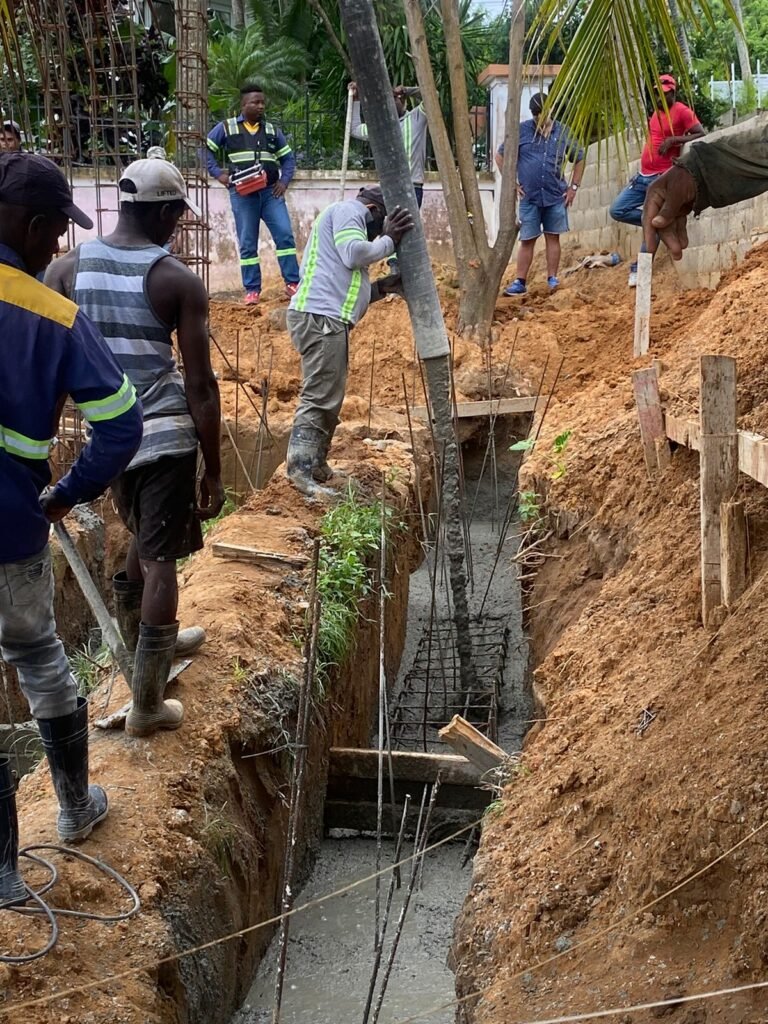
Watch the lot after a heavy rain if you can, or ask the neighbours. Water running across the lot, a low point where it collects, or a neighbour’s drain pointing at you are all things we have to solve with grading, channels or a raised floor level.
9. How does water reach the lot?
Some lots have a municipal water connection. Others depend on a well, a cistern filled by truck, or both. Most homes on the north coast have a cistern and a pump anyway, because the public supply is not constant. Ask the seller and the neighbours how they get water today.
10. How far is the nearest power line?
Electricity on the north coast is supplied by EDENORTE. If the line is far from your lot, you may need poles, a transformer or both, and that takes time to approve and install. Check how far the closest pole is and whether the neighbours have reliable service. Many owners also plan for a generator or solar with batteries.
11. How will sewage be handled?
Most lots outside town centres are not connected to a public sewer. That means a septic system sized for the house, placed with the right distance from wells, cisterns and boundaries. On small or rocky lots, fitting it in is a design decision, not an afterthought.
12. What is the real buildable area?
Take the lot size, then subtract:
- the coastal public zone, if any;
- front, side and rear setbacks required by the municipality or the community rules;
- easements (paths, power lines, drainage);
- areas too steep or too wet to build on.
What is left is where your house, pool and terrace can go. In gated communities, the HOA rules can also limit height, roof type, colours and minimum house size. Ask for them before you buy.
Quick checklist: before you pay a deposit
| # | Check | Who checks | Done? |
|---|---|---|---|
| 1 | Title registered in seller’s name | Lawyer | ☐ |
| 2 | Individual deslinde | Lawyer | ☐ |
| 3 | No liens, disputes or occupants | Lawyer + builder (site visit) | ☐ |
| 4 | Outside coastal, river and protected zones (or impact understood) | Lawyer + municipality | ☐ |
| 5 | Truck access for concrete and materials | Builder | ☐ |
| 6 | Slope and foundation type | Builder / engineer | ☐ |
| 7 | Soil (study if needed) | Engineer | ☐ |
| 8 | Drainage | Builder | ☐ |
| 9 | Water source | Builder + seller | ☐ |
| 10 | Distance to power (EDENORTE) | Builder | ☐ |
| 11 | Space for septic system | Builder / engineer | ☐ |
| 12 | Real buildable area after setbacks and HOA rules | Builder + lawyer | ☐ |
How much does a bad lot add to the build?
There is no single number, because every lot is different. What we can say is where the money goes: retaining walls and earthwork on slopes, deeper foundations on soft soil, poles and transformers when power is far, and extra labour when trucks cannot reach. That is why we visit the lot and look at access, slope and soil before giving a quote.
For the cost of the house itself, see how much it costs to build a house in Cabarete.
What we do when a client asks us to look at a lot
- We visit the lot with you or send you photos and video if you are abroad (see building your villa from abroad).
- We check access, slope, drainage, water, power and sewage on site.
- We give you a written list of what the lot will need and a rough idea of how it affects the budget.
- We tell you what your lawyer still needs to confirm.
Saiz Solutions Builders is a family construction company based in Encuentro, Cabarete, building homes, villas and pools in Cabarete, Sosúa and Puerto Plata. If you are about to buy a lot, send us the location and the listing on WhatsApp and we will tell you what we see before you sign. Or request a quote if you already own it.
FAQ
Can I build on a lot that does not have its own deslinde yet?
In practice, no. The building permit requires the final title and the cadastral plan of the lot, so the deslinde has to be completed first. Your lawyer can tell you how long that will take for a specific parcel.
Is it better to buy a lot in a gated community or an independent lot?
Gated communities usually have roads, power and water in place, and clear rules. Independent lots can be cheaper and more flexible but need more checks on access and services. Ask for the community rules before you buy, because they can limit your design.
How close to the beach can I build in the Dominican Republic?
The first 60 metres from the high-tide line are public land and cannot be built on. Additional restrictions can apply depending on the area. Confirm the exact limits for your lot with a lawyer and the municipality.
Do I need a soil study before buying?
Not always before buying, but always before designing the foundation on coastal, filled or sloped land. If the lot looks doubtful, it is worth doing before you commit.
Will you look at a lot before I buy it?
Yes. Send the location and the listing and we will tell you what the lot will need to be built on.
